What does the Annapurna Base Camp trek actually cost?
A real 2026 budget breakdown, in USD and RM
Quick answers
Why ABC costs less than the Circuit
It comes down to length. ABC is a six-day walk — the route we measured is 54.72 km round trip; the Annapurna Circuit is about fourteen days. The daily teahouse rate is similar on both, but on ABC it accumulates over less than half the time, and there’s no expensive Jomsom mountain flight to buy. That’s why the totals below run well under a full Circuit.
The daily on-trail budget
For most independent trekkers in 2026, USD 25–40 per day covers a bed, three meals, and small extras. The one thing that pushes it up is altitude: everything above Chhomrong is carried up by porter or mule, so a plate that is cheap in the lower valley costs more at Deurali or base camp.
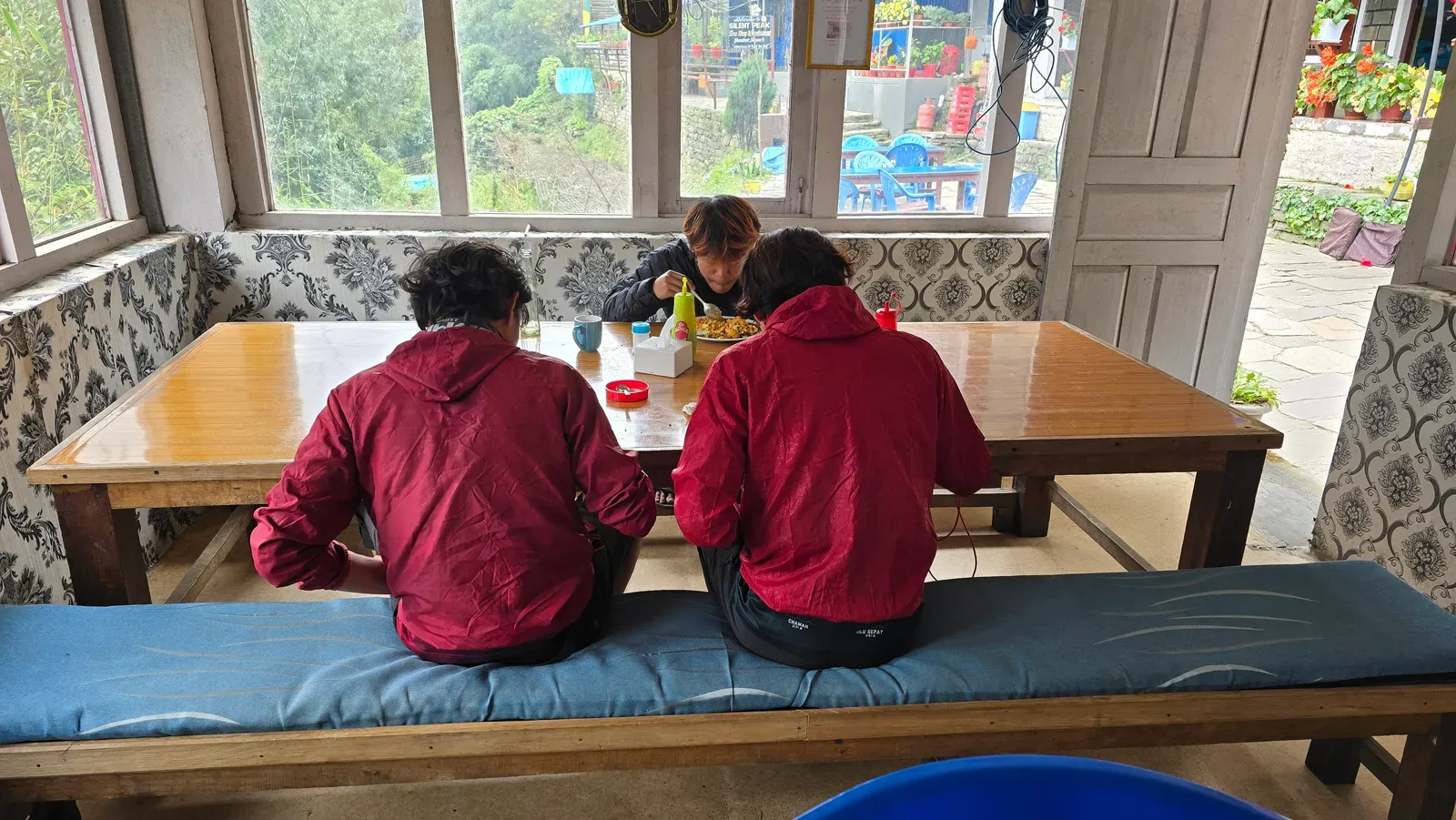
| On the trail (per person/day) | Lower valley | Near base camp |
|---|---|---|
| Teahouse room (twin, shared bath) | USD 3–8 | USD 8–15 |
| A meal (dal bhat, pasta, etc.) | USD 4–8 | USD 8–13 |
| Hot shower | NPR 150–300 (USD 1–2.5) | often gas/none |
| Wi-Fi | NPR 100–300 (USD 1–3) | same / patchy |
| Phone/battery charging | NPR 100–200 (USD 1–2) | USD 2–3 |
Money-saver: dal bhat (NPR 850–980 ≈ USD 6–7) comes with unlimited refills — the best value and best fuel on the trail. Rooms are often cheap, or near-free, if you eat dinner and breakfast at the same lodge, which is the normal teahouse deal on this route.
What a plate actually costs
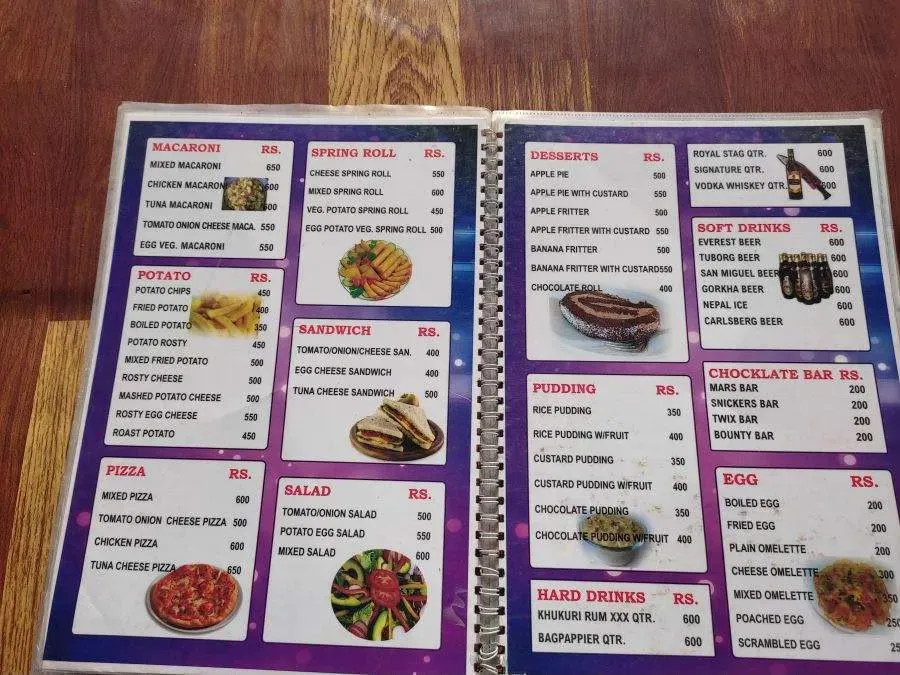
First-hand · a teahouse menu Kak Yaa recorded on the trail, 2026
| Dish | NPR | ≈ RM |
|---|---|---|
| Plain rice | 600 | 20 |
| Vege fried rice | 750 | 25 |
| Egg & vege fried rice | 850 | 29 |
| Mixed fried rice | 930 | 31 |
| Egg curry with rice (2 egg) | 1,150 | 39 |
| Vege momo | 800 | 27 |
| Egg, vege & cheese momo | 850 | 29 |
| Potato, tuna & cheese momo | 870 | 29 |
| Mixed momo | 950 | 32 |
| Vege fried noodle | 750 | 25 |
| Egg & vege fried noodle | 850 | 29 |
| Mixed fried noodle | 900 | 30 |
| Dal bhat (unlimited refills) | 850–980 | 29–33 |
At ≈ NPR 133 to the US dollar, that’s roughly USD 4.50–8.60 a plate. This is upper-sanctuary pricing — the level you hit around Deurali (3,152 m) and base camp (4,131 m) on our route, where every plate arrives on a porter’s back or a mule. Down at Chhomrong or Bamboo the same dishes run cheaper.
The permit
The ACAP (Annapurna Conservation Area Permit) is NPR 3,000 (≈ USD 23) for foreigners — the one certain, fixed cost of the whole trek, bought in Pokhara or Kathmandu. A TIMS card (NPR 2,000 ≈ USD 15) is officially listed but rarely enforced on the Annapurna trails, so budget it as a maybe. There’s no separate national-park fee beyond the ACAP. Full, dated detail — including the contested guide rule — is in our Annapurna permits & the guide rule guide.
Transfers
ABC is run from Pokhara, not Kathmandu, so the transfer bill is smaller than the Circuit’s. The route we measured starts at the Siwai roadhead; the classic route starts a little lower at Nayapul.
| Leg | Option | Cost |
|---|---|---|
| Kathmandu → Pokhara | Tourist bus (~7 h) | USD 10–15 |
| Flight | USD 110–125 | |
| Pokhara → Siwai / Nayapul roadhead | Private jeep (~2.5–3 h) | USD 90–140 (split between trekkers) |
| Local bus + shared jeep | far cheaper per seat, much longer | |
| Roadhead → Pokhara (return) | Shared jeep | per seat, negotiated locally |
Sharing a private jeep to and from the roadhead is the usual way to skip the slow, dusty lower road — split four or five ways it is reasonable, and it is the single biggest transfer saving on this trek.
Guide and porter
Whether you need a guide on the Annapurna trails in 2026 is genuinely contested — the trails are well-marked and widely walked independently, but a 2023 regulation is on the books and enforcement is inconsistent. Here is what one costs if you take, or are required to take, one:
| Support | Typical 2026 rate |
|---|---|
| Licensed guide | USD 25–35/day |
| Porter | USD 20–25/day (often carries for two) |
| Combined porter-guide | between the two |
| Tips (customary, extra) | guide ≈ USD 8–10/day · porter ≈ USD 5–7/day |
Over a six-day walk, a guide adds roughly USD 150–250 plus tips; a porter-guide combo roughly USD 120–200. If you hire, do it through a licensed agency so the guide is properly licensed and the porter is insured and equipped. A porter is worth serious thought on ABC specifically: our difficulty guide found the injuries land on the descent, and a lighter pack on the stone steps into Chhomrong is real protection, not luxury.
What it actually adds up to
Realistic ranges for the ABC trek, excluding international flights to Nepal. First, where the money goes on a typical independent walk — each cost stacked to the total:
And the range across styles:
| Style | USD | RM (approx) |
|---|---|---|
| Tight budget — solo, dal bhat, local bus + shared jeep, no extras | ~USD 250–320 | ≈ RM 1,100–1,450 |
| Comfortable independent — better rooms, private jeep share, Wi-Fi, showers | ~USD 380–480 | ≈ RM 1,700–2,150 |
| Independent + porter-guide | ~USD 450–650 | ≈ RM 2,000–2,900 |
| Guided package (permit, guide, porter, meals, 7–10 days) | ~USD 400–900 | ≈ RM 1,800–4,100 |
Guided package prices vary widely with group size, inclusions and season — a solo private guided trip sits at the top, a larger group toward the bottom. Prices across the board rise in the October–November and March–April peak.
What a real guided package looks like
First-hand · a 2026 package run by Ohana Travel & Tours
A concrete example — the operator our contributor supports. We’re listed as a contact for Ohana, so we flag the connection and present it as a reference point, not a recommendation. Prices per person, in RM:
| Ohana 2026 (per person) | RM |
|---|---|
| Land package — trek, guide, teahouses, all meals (B/L/D, set teahouse menu), domestic transfers | 1,899 |
| International flight (KUL ⇄ Kathmandu, average season) | ~2,000 |
| Porter — shared, up to 12 kg | 300 |
| Porter — personal, up to 15 kg | 600 |
| Nepal visa | 150 |
| Tips (guide + porter, customary) | 70–80 |
With a shared porter and flights, that’s about RM 4,400 (≈ USD 980) all-in — or roughly RM 2,400 (≈ USD 530) land-only if you book your own flight. Because breakfast, lunch and dinner are all included (set teahouse meals), the à-la-carte menu above is what you’d otherwise be paying out of pocket.
Costs people forget
- Cash is king. Reliable ATMs stop at Pokhara — carry enough Nepali rupees for the whole trek, as upper-valley lodges don’t take cards.
- Water adds up. Bottled water climbs toward USD 2–3 near base camp — bring a filter or purification tablets and refill instead. Cheaper, and less plastic.
- Travel insurance with helicopter-evacuation cover is essential, not optional, at 4,130 m — budget it separately.
- Poles you’ll actually use. A usable pair in Pokhara starts around RM 30 and runs to about RM 300 — cheap insurance for the descent our difficulty guide is built around.
- Gear you don’t already own, the Nepal visa (USD 30–50 depending on length), and Pokhara nights before and after the walk.
What it cost us (coming after the walk)
Kak Yaa’s teahouse menu and the Ohana package are first-hand 2026 figures, and the route was measured by Kani in October 2025 — but the day-by-day spend was never logged as ours. keitreks Chapter One is the Annapurna Circuit in November 2026. When we hold real ABC receipts — every teahouse bill, jeep seat and charging fee — we’ll publish the actual day-by-day cost so you can budget against numbers we stood behind, not estimates. That is the keitreks standard: the numbers are measured; the trail is next.
How we know this
We keep the measured and the sourced apart on purpose — and mark which is which:
- The routeMeasured
- 54.72 km round trip, six walking days, recorded by Kani (Ohana trip leader) on a COROS watch, October 2025 — the one part of this page that is ours.
- Menu & packageFirst-hand
- The teahouse menu and the Ohana package prices are recorded first-hand by Kak Yaa in 2026. She supports Malaysian groups for Ohana, which we're listed as a contact for — so the package is a disclosed reference, not a recommendation.
- The rangesSourced
- The daily-budget spread, transfers and guide/porter rates are 2026 sourced ranges, corroborated across current Annapurna cost guides. They move with lodge, season and exchange rate.

Permit: Nepal Tourism Board — ACAP NPR 3,000 for foreigners (TIMS NPR 2,000, officially listed, rarely enforced). See the permits guide.
Status: Kak Yaa's menu and the Ohana package are first-hand 2026 figures; the daily ranges are sourced, not measured by us. Prices rise with altitude and move with season and exchange rate. Our own logged day-by-day spend follows a KeiTreks walk.
Educational planning content, not financial advice. Some links are affiliate links; we only recommend what we'd use ourselves, at no extra cost to you.
Related: Trek cost calculator · Annapurna Base Camp itinerary · ABC route map & elevation · ABC difficulty · Permits & the guide rule · Annapurna vs Everest Base Camp · Everest Base Camp cost
Frequently asked
How much does the Annapurna Base Camp trek cost in 2026?
How much does Annapurna Base Camp cost without a guide?
How much is the Annapurna Base Camp permit?
What is the daily budget on the Annapurna Base Camp trek?
How much does food cost on the Annapurna Base Camp trek?
How much does a guide or porter cost for Annapurna Base Camp?
Are meals included in a guided Annapurna Base Camp trek package?
Is Annapurna Base Camp cheaper than the Annapurna Circuit?
Can you do the Annapurna Base Camp trek on a tight budget?
Discussion
Loading discussion…